
“My sister and I went to school on the opposite side of the mountain,” says Héðinn Birnir Ásbjörnsson, pointing across the fjord. “When the roads closed in October or November, we stayed there for a week. In the first years, we had a boat traveling from here to the opposite side, and then we drove, but later on, we bought snowmobiles.”
Where did I end up this time? I’m back in remote Strandir, and the history-soaked, slightly mysterious Djúpavík. Héðinn is my guide around the old herring factory today. He’s also the son of its owners — Ásbjörn Þorgilsson and Eva Sigurbjörnsdóttir — who bought the abandoned site and moved to this far-flung fjord in the 1980s.
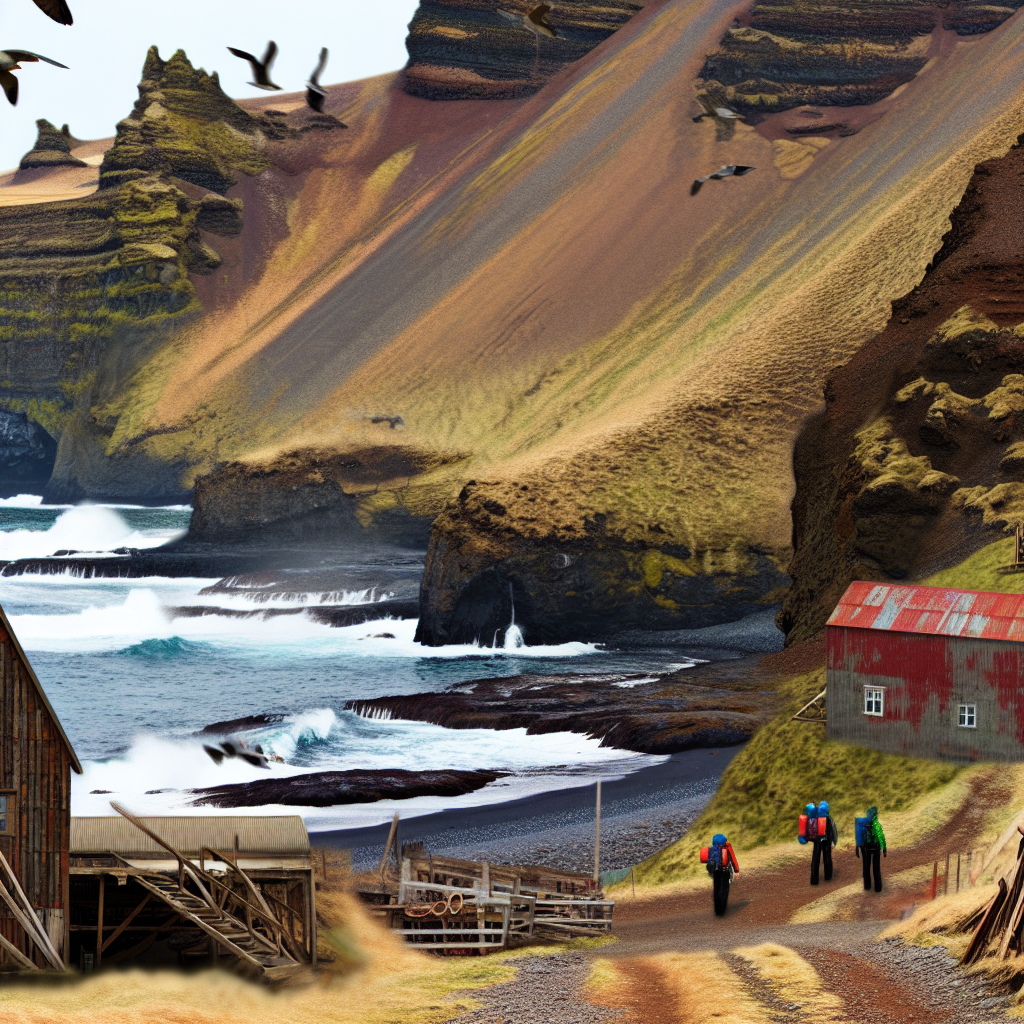
If you’ve never been to Djúpavík, picture this: just a handful of wooden houses, a thin waterfall trickling down the mountain behind, a charming little hotel (with the two owners, its sole year-round residents), a wreck of a rusty ship, and huge industrial remains of what used to be a thriving herring factory. Across the fjord, a mountain with its snowy cap and dark rocks peeking through looks just like a scoop of Oreo ice cream. The stillness of the landscape is broken only by a sudden cluster of birds. I grew up in a big city, and a place like this has a weird, magical pull. Héðinn shakes his head. As a teenager, he’d try to escape whenever possible. “I didn’t appreciate what I was a part of,” he says.
Photo by Art Bicnick
The gold rush
Héðinn’s parents bought the factory thinking they could start fish breeding in its former fish oil tanks. But struggling to finance it, they shifted the focus to tourism while still thinking of innovative ways to use the factory, such as its annual art exhibitions (for more of this, see Issue 8, 2025).
“For this time and era, it was actually a very big house,” says Héðinn as he lets me into the herring processing part of the building, still filled with relics of old equipment. “It’s 6,500 square meters, to put that in perspective, the footprint of the Smáralind shopping mall is approximately 14,000 square meters.”
He adds, “It wasn’t just a big lump of concrete — it was actually the most advanced factory of its kind in Europe.” When it opened in 1935, the equipment and level of automation were of a very high standard.
“There was electricity in all houses, a doctor, a bakery, a shop — you could even fly here directly from Reykjavík on a seaplane. It went from nobody living here to a booming little place. You might say it was a kind of gold rush.”
Djúpavík blossomed around the factory as more and more workers flocked to the area. “In a very short period, it had the infrastructure of a modern-day town for that era,” says Héðinn. “There was electricity in all houses, a doctor, a bakery, a shop — you could even fly here directly from Reykjavík on a seaplane. It went from nobody living here to a booming little place. You might say it was a kind of gold rush.”
Ninety years later — the factory just celebrated its birthday on July 7 — almost none of those amenities remain in Djúpavík. The Westfjords aren’t connected to Iceland’s main power grid, so while there ice electricity, the connection isn’t always reliable, and power cuts happen. These days, the small hotel run by Héðinn’s family, the tours of the old factory, and the rare moments Djúpavík serves as a movie backdrop, keep this remote place alive.
In fact, what we now know today as Hotel Djúpavík was originally built as the factory’s women’s quarters. In its heyday each room had bunk beds for up to eight women housing as many as 100 in total. Today, it offers just eight double rooms. Women were a vital part of factory operations, primarily salting herring for export.
“At the height, there were around 250 people living in Djúpavík,” says Héðinn, adding that some historical records suggest that during the peak of construction, that number may have actually climbed as high as 450.
Heavy lifting
Héðinn walks us around the factory, telling the story in such an engaging way that even a non-history buff like me is completely captivated for the entire tour. We stop near the rusty, ceiling-high 60-tonne boiler that once powered the operation.
“The biggest engineering problem was actually getting this thing here,” he says. “There were no cranes in Iceland strong enough to lift a 60-tonne thing, not even in Reykjavík. They had to think out of the box.”
So, instead of buying a new boiler, the factory bought a shipwreck stranded on the south coast. “They bought the ship for only one purpose — to recycle its boiler.”
It took about four months to move the ship — first from the south coast to Reykjavík harbour, then up to the Westfjords. Once it finally arrived in Djúpavík, the real challenge began: how on earth do you get a 60-tonne boiler out of the sea and into the factory? With construction already underway, only three men were spared to handle the job. They rolled it out of the water like a barrel — except there was a massive steam valve sticking out, stopping it from rolling smoothly. So, every time they turned it, they had to dig a hole to make space for the valve. Winches helped, but even then it took about three weeks. Whether this is a tale Héðinn likes to tell tourists or an actual feat of Westfjords engineering wizardry — it’s pretty damn impressive.
There’s another ship story connected to the place — the one about the now-dilapidated coaster, slowly living its last days on the Djúpavík shore. During the factory’s boom years, housing was a huge problem. There simply weren’t enough hands or time to build accommodation quickly enough for all the workers. To solve this, the management bought the MS Suðurland, a ship that could house about 30 factory workers. Fun fact from Héðinn: Originally built to serve on the lakes of Sweden, the ship was mistakenly bought by the Icelandic state — it was never meant to sail in ocean waters.
Photo by Art Bicnick
Photo by Art Bicnick
A Basque-Icelandic connection
When we finally step outside the factory, Héðinn points to one of the tanks, “This one won the BAFTA a year ago,” he says, cracking up at his own joke. What he means is the composer Atli Örvarsson, who received a BAFTA for his score in the TV series Silo. Atli recorded some of the sounds for the score right inside this fish oil tank.
Next to this tank stands the new addition to Héðinn’s family’s attempts to find a new purpose for the factory: the Basque Centre, the first phase of which opened last summer. What is the Basque connection to this remote corner of the country? The Basques, believed to have been the first nation to do commercial whaling, started hunting whales around the Westfjords in the 17th century. In 1615, harsh weather wrecked their ships and those stranded got into conflict with locals, leading to Spánverjavígin (The Slaying of the Spaniards), in which at least 32 Basques were killed.
“My idea was to do something with that particular history,” Héðinn says. But rather than focusing on its depressing chapter — the part where Icelanders killed a bunch of Basques — the center looks at the relationship between the two nations, both speaking languages no one understands. Right now, the centre’s main exhibit is the half-finished hull of a Basque boat built by Icelandic carpenters. Héðinn admires the Basques’ boat-building skills, “They were second to none, the best in the world. They built ships able to cross the Atlantic, and had the know-how and experience no other nation had at the time,” he says, adding that he hopes that one day the boat will be finished — and that a team of Icelandic and Basque rowers will sail it together through the fjord, “Just for fun.”
We finish our conversation, and Héðinn is off running his chores around the factory. I spend the rest of the afternoon sitting in a camping chair, binoculars in hand, counting eider ducks in the bay and admiring baby duck chicks learning to swim. I don’t remember a place that felt more peaceful. I think back to something Héðinn said earlier. “It’s a question of postponing the regrettable demise of the building. It’s going to happen eventually. But we believe that this particular house, this structure, has a story to tell.”
This is the second piece in a series of articles from our recent trip to Strandir. Thank you Hotel Djúpavik for the accommodation and Go Car Rental for the wheels. Book your car at gocarrental.isand don’t miss Héðinn’s factory tour when you visit Djúpavík.