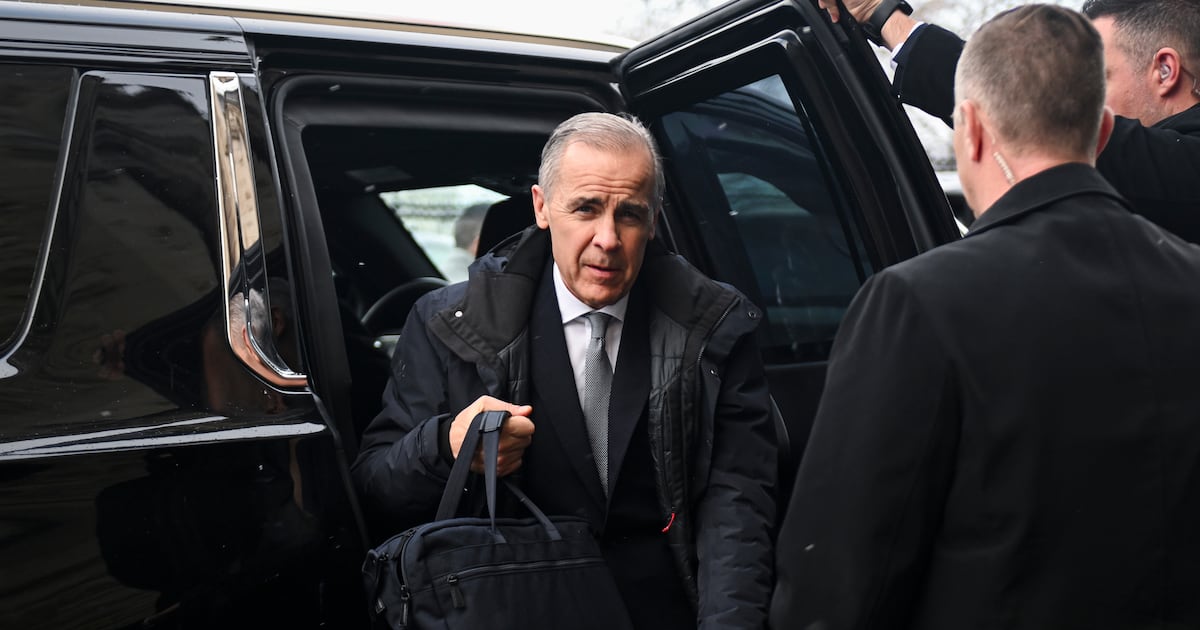
OTTAWA — On his first official visit to Norway as prime minister, Mark Carney will meet with Nordic leaders with aims to deepen defense cooperation in the Arctic while pitching investment in Canada’s North.
Defense Minister David McGuinty and Stephen Fuhr, Secretary of State for Defense Procurement, will join Carney on the trip to northern Europe. The meeting will mark the first time a Canadian prime minister has conducted an official visit to Norway since 1980.
During a background briefing, senior government officials told reporters that Nordic leaders are interested in hearing more about Carney’s ideas on how middle powers can work together to advance their interests following his speech last month in Davos, Switzerland.
“Canada’s standing in the Nordic region has never been higher. The Nordic countries look at Canada as an important player economically, demographically and as members of the G7,” officials said.
The visit also comes at a time when US President Donald Trump has threatened the sovereignty of both Canada and Greenland. On Tuesday, Trump referred to Carney as a “future governor” in a social media post on Truth Social.
Before heading overseas, the delegation will make a pit stop in Yellowknife, NT., to make an announcement related to major project development and defence.
Once in Norway, Carney will participate in a trilateral meeting with Prime Minister Jonas Gahr Støre and German Chancellor Friedrich Merz on Friday in Bardufoss. The two European countries are backing the TKMS submarine bid to build twelve vessels for Canada.
In the briefing, a source said that submarines are “not expected to be part of the official programme,” as the bids are still being assessed.
In Bardufoss, the three leaders will observe 25,000 NATO troops practicing Cold Response drills, including a contingent of Canadian special operations forces.
Soldiers from 14 nations are conducting training exercises on land, sea and air in the Arctic Circle.
Deep pockets in the Nordic Region
Then on Saturday, in Oslo, Carney will meet with Scandinavian business executives, followed by the Nordic Council-Canada summit when Carney will sit down with the leaders of Norway, Sweden, Denmark, Finland and Iceland.
Seeking foreign direct investment into Canada and new sources of foreign capital “is at the heart of every international engagement with both political and corporate leaders,” said a senior government source.
They noted that Norway has one of the largest sovereign wealth funds in the world and “sophisticated and deep‑pocketed investors.”
Carney’s office says he will aim to position Canada as a “premier” destination for investment in defence, critical minerals and artificial intelligence.
The Liberal government pledged to spend $81.8 billion on defense in Budget 2025. Of that amount, $6.6 billion will be directed to the recently released Defense Industrial Strategy.
Industry Minister Mélanie Joly said that Canada’s new Arctic foreign policy is “fundamentally about investing and creating jobs.”
“You will see the Prime Minister in the coming days and months showing how much this is an important region for Canada and the world,” Joly said on Wednesday as she walked into caucus.
“We’re putting our money where our mouth is.”
Neglect is bigger risk to sovereignty
Artur Wilczynski, who served as Canada’s ambassador to Norway between 2014 and 2018, says this visit by Carney sends an important message.
“Both Sweden and Finland have recently joined NATO. Denmark is also a longstanding partner. The fact that (Carney) is meeting all the Nordics while he’s there shows that our countries can cooperate more on security and defence.”
Wilczynski, who is a senior fellow at the Graduate School of Public and International Affairs at the University of Ottawa, says Canada can learn a lot about security from the Nordic nations that border Russia and their experience during the Cold War and the ongoing war in Ukraine.
The former diplomat says Canada should also take note of how Norway has invested in roads, schools, housing and healthcare for the people of the North.
He says there is a marked difference in the standard of living for people in the European Arctic compared to Canada’s North. That, he says, is a greater risk to Canada’s sovereignty than Russian, Chinese or American military threats.
“I’m more concerned about our sovereignty being whittled away by neglect, by the fact that the people of the Arctic don’t feel that the Canadian government and the people of Canada actually care about their well-being.”
Following his visit to Norway, the prime minister will stop over in the United Kingdom, where he will meet with British Prime Minister Keir Starmer at 10 Downing Street. The two leaders are expected to discuss the war in the Middle East.
An extended trip
After his bilateral meeting with Starmer, Carney will not be returning home with the Canadian delegation. Instead, the Prime Minister’s Office (PMO) says he “will remain in Europe for personal commitments,” until March 22.
“During this period, the Prime Minister will remain in close coordination with his team and officials on several critical priorities,” officials with the PMO wrote in response to a query from CTV News.
While government officials and reporters return to Canada on the Airbus, a second plane will stay with Carney overseas. The federal government owns a fleet of Challenger jets that is used for transporting VIPs across Canada or on short international flights.
As per long standing government policy and for security reasons, the Prime Minister must travel on government aircraft whether on official or personal business. Because Carney is traveling for personal reasons, the Prime Minister will reimburse travel costs equivalent to commercial airfares, as has been the case with past Canadian leaders.