

From ships to churches to living history, immerse yourself in Norse history and culture with this Viking travel guide to Norway.
If Norway’s 2026 World Cup run has put the country on your radar, you may already have seen the “Viking Row” celebration from players and fans. It is a fun, modern piece of football theatre, but it also points to something much deeper.
The Viking image remains one of Norway’s strongest cultural exports. Long before football shirts, social media clips and stadium celebrations, the seafarers of Scandinavia were crossing oceans, founding settlements, trading goods, raiding coastlines and shaping the history of Europe.
So, if the World Cup has inspired you to learn more about Norway, why not plan a trip with a Viking theme?
From reconstructed longhouses and burial mounds to stave churches, digital museums and full-size ships, Norway offers many ways to explore the Viking Age. The challenge is that the best places are spread all over the country, so this is not a simple one-stop itinerary.
That is also part of the appeal. Wherever you travel in Norway, there is a good chance you will not be far from a Viking story.
An Short Introduction to the Viking Age
The Viking Age is generally used to describe the period from the late 8th century to the mid-11th century, when Norse seafarers from what is now Norway, Denmark and Sweden expanded across Europe and beyond.
The Vikings were not just raiders. They were traders, farmers, craftspeople, explorers, shipbuilders and settlers. Their ships took them across the North Sea, along the rivers of Europe, into the Mediterranean, across the North Atlantic and eventually to North America.
Norway’s long coastline, deep fjords and island communities shaped that maritime culture. The sea was not a barrier. It was a highway.
Modern Viking tourism in Norway is therefore about far more than horned helmets, which, by the way, are not historically accurate. It is about ships, trade routes, burial customs, political power, craft traditions, mythology, religion and the gradual transition from Norse beliefs to Christianity.
Oslo: The Viking Museum That Isn’t Yet Open
For many years, Oslo was the obvious starting point for Viking travel in Norway. The Viking Ship Museum on Bygdøy was home to three of the world’s most important Viking ships: the Oseberg, Gokstad and Tune ships. That museum is currently closed.
The ships and many of the objects from the old museum are being conserved and protected as part of a major redevelopment.
The site is due to reopen as the Museum of the Viking Age, a much larger and more modern museum dedicated to Viking history. At the time of writing, the planned opening is late 2027, although large museum projects can change.
This is important for 2026 visitors. If you are coming to Norway this year, you will not be able to see the original Viking ships in Oslo.
That does not mean you should ignore Oslo. The city still makes sense as a gateway, especially if you are flying in from overseas.
It is also home to The Viking Planet, a digital Viking museum near City Hall. Through virtual reality, holograms, interactive displays and immersive film, it offers a very different way to engage with Viking history.
Also on Bygdøy, the Norwegian Museum of Cultural History is worth considering. It is not a Viking museum as such, but its open-air collection includes Gol Stave Church, moved from Hallingdal and rebuilt in Oslo. It is a useful introduction to the later medieval world that followed the Viking Age.
But for the best Viking experiences in 2026, you will need to leave the capital.
Vestfold: Norway’s Viking Heartland
If you want to build a Viking-themed trip from Oslo, Vestfold is the place to start.
This region along the western side of the Oslofjord has some of Norway’s most important Viking sites. The Oseberg ship was found near Tønsberg, the Gokstad ship near Sandefjord, and the Borre burial mounds remain one of the most impressive Viking landscapes in the country.
Tønsberg is a particularly good base. Often described as Norway’s oldest city, it has a pleasant harbour, medieval ruins and a strong connection to the Oseberg story.
The original Oseberg ship is not in Tønsberg, but a full-scale archaeological replica, Saga Oseberg, can usually be seen in the harbour. Built using Viking Age tools and methods, it gives a much better sense of scale than a ship behind glass ever could.
Nearby, the Oseberg burial mound itself is a more understated experience, but it is worth visiting if you want to connect the museum object with the landscape where it was found.
North of Tønsberg, Midgard Viking Centre at Borre is one of the best places in Norway to understand Viking power and status. The centre stands beside the Borre burial mounds, a remarkable collection of monumental graves associated with elite families and rulers.
The reconstructed Viking hall at Midgard helps bring that world to life. Rather than focusing only on ships and raids, Borre gives visitors a sense of chieftains, feasting, political networks and ritual landscapes.
Further south, Kaupang near Larvik is another important stop. Often described as Norway’s first town, Kaupang was a Viking trading place established around the year 800. In summer, visitors can learn about trade, crafts, religion, food culture and daily life in a settlement that connected Norway to wider trading networks.
For many visitors, Vestfold offers the most coherent Viking itinerary in Norway. You can explore ship burials, burial mounds, reconstructed buildings, harbour towns and archaeological landscapes within a relatively compact area.
Viking Experiences in Fjord Norway
Western Norway gives a very different perspective on the Viking Age. Here, dramatic fjords and coastal sailing routes help explain why ships mattered so much.
One of the most popular Viking experiences in the fjord region is Viking Valley in Gudvangen, also known as Njardarheimr. Gudvangen sits at the end of the Nærøyfjord, one of the most spectacular branches of the Sognefjord and a common stop on the popular fjord route from Flåm.
Viking Valley is a reconstructed Viking village populated by guides and enthusiasts who demonstrate crafts, storytelling, archery, axe throwing and aspects of everyday life. It is theatrical, yes, but it is also engaging, especially for families and first-time visitors.
Because Gudvangen is already on so many Norway itineraries, this is one of the easiest Viking experiences to add to a fjord trip.
Further south, Avaldsnes on Karmøy near Haugesund is one of Norway’s most important royal sites. The Nordvegen History Centre tells the story of the rulers who controlled the “North Way,” the shipping route that eventually gave Norway its name.
Avaldsnes is strongly associated with Harald Fairhair and the early unification of Norway. The nearby Viking Farm on Bukkøy is open in summer and offers guided tours of reconstructed buildings, giving visitors a sense of domestic life as well as royal power.
If you are travelling between Stavanger and Bergen, Avaldsnes is a worthwhile detour. It also pairs well with the Swords in Rock monument at Hafrsfjord near Stavanger, which commemorates the battle traditionally associated with Harald Fairhair’s unification of Norway.
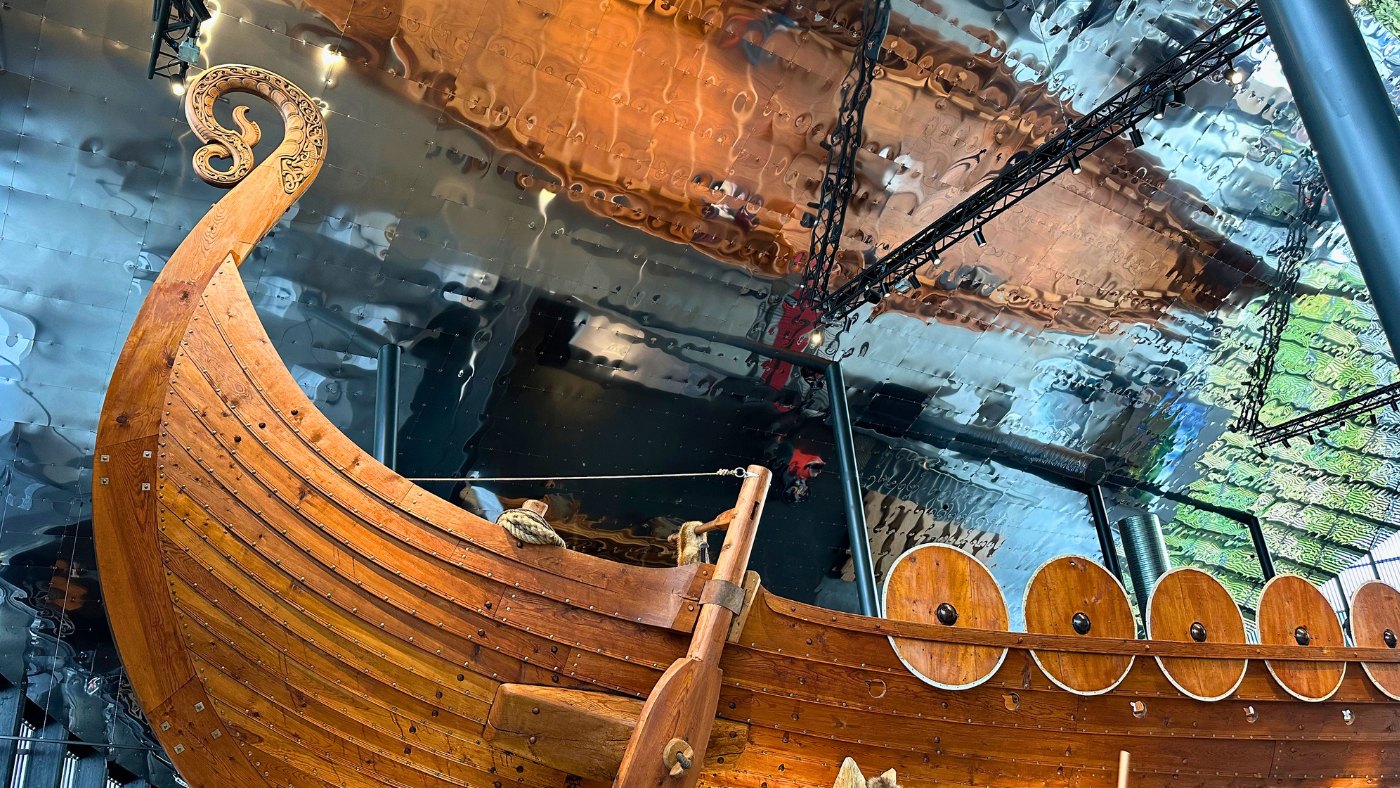
Further north in Nordfjord, Sagastad in Nordfjordeid has become one of Norway’s most impressive Viking attractions. Its centrepiece is the Myklebust ship, a 30-metre reconstruction of what is considered the largest known Viking ship from Norway.
Unlike the fragile original ships from the Oslofjord burials, this reconstruction can be experienced up close. Visitors can step aboard, learn about the burial mound where the ship was found, and explore the story of power on Norway’s west coast.
Hyllestad, on the north side of the Sognefjord, offers another angle entirely. The Millstone Park focuses on stone quarries rather than ships or battles. During the Viking Age and Middle Ages, millstones from Hyllestad were produced on a large scale and traded widely.
Lofoten: The Chieftain’s Longhouse
For a Viking experience in Northern Norway, Lofotr Viking Museum in Lofoten is the obvious choice.
Located at Borg on Vestvågøy, the museum is based on the discovery of an unusually large chieftain’s longhouse. The reconstructed building is 83 metres long, making it one of the most memorable Viking interiors in Norway.
Lofotr works especially well because the setting is so powerful. The Lofoten landscape of mountains, sea, farmland and fishing villages helps visitors understand how coastal communities lived with one eye on the land and one on the ocean.
In summer, the museum offers activities such as craft demonstrations, rowing, archery and Viking-style meals. Many cruise passengers visit Lofotr on organised excursions, but independent travellers exploring Lofoten by car can also include it easily.
If you are already planning a trip to Lofoten, then Lofotr should be high on the list. If you are not, it is probably too far to include on a short Viking-themed trip unless Northern Norway is your main focus.
Trondheim, Stiklestad & the End of the Viking Age
Not all Viking travel is about longships and pagan gods. Some of Norway’s most important Viking stories are about the transition to Christianity and the emergence of a more unified kingdom.
Trondheim is central to that story. Nidaros Cathedral stands over the traditional burial place of Olav Haraldsson, the Viking king who became Saint Olav after his death. The cathedral became one of Northern Europe’s great pilgrimage destinations and remains Norway’s national shrine.
To understand why that matters, travel north of Trondheim to Stiklestad. It was here, in 1030, that Olav Haraldsson was killed in battle. His death became a turning point in Norwegian history, linked to the consolidation of Christianity and royal power.
Stiklestad National Cultural Centre tells that story through exhibitions, historic buildings and summer events. It is especially relevant now as Norway moves toward the national jubilee in 2030, marking 1,000 years since the Battle of Stiklestad.
Stave Churches and the Viking Legacy
Norway’s stave churches belong to the Christian Middle Ages rather than the Viking Age itself, but they are still an important part of the story.
These wooden churches used building skills that developed from Norway’s older woodworking traditions, including shipbuilding. Their carved portals, animal ornamentation and dragon-like details often appear to echo older Norse symbolism, even though the buildings were Christian.
There were once more than 1,000 stave churches in Norway. Today, 28 remain.
Borgund Stave Church in Lærdal is one of the best preserved and can be combined with a fjord itinerary. Urnes Stave Church, near the Lustrafjord, is Norway’s oldest stave church and a UNESCO World Heritage Site. Heddal, in Telemark, is the largest.
Stave churches are not “Viking churches,” but they are one of the clearest visual links between Viking Age craft and medieval Christian Norway.
Viking Festivals in Norway
For the most atmospheric Viking experiences, time your trip around a festival.
Tønsberg Viking Festival is one of the most accessible, especially if you are based in Oslo or travelling through Vestfold. The harbour setting, Viking ships, market, lectures, music and crafts make it a strong choice for visitors who want atmosphere as well as history.
Avaldsnes Viking Festival, held in June, is another major event. Vikings from many countries gather at the Viking Farm, creating a lively market and living history environment.
Other events take place around the country, including at Midgard and other historic sites. Dates vary from year to year, so always check the latest programme before planning your trip around a festival.
Planning A Viking Trip To Norway
A Viking-themed trip to Norway is not about ticking off a single museum. In fact, while Oslo’s new Museum of the Viking Age is under construction, the best approach is to think regionally.
Vestfold is best for archaeological depth. Fjord Norway is best for scenery and living history. Lofoten is best for atmosphere. Trondheim and Stiklestad are best for understanding the end of the Viking Age.
The best trips combine several types of experience: a burial mound, a reconstructed building, a ship, a church, a landscape and a museum. That way, the Viking Age becomes more than a costume or a football celebration. It becomes a real part of Norway’s landscape, history and identity.
And if your interest began with the Viking Row at the World Cup? All the better. Modern Norway may be a wealthy, peaceful, high-tech country, but the old stories are never very far away.