I’m an office rat. I love staring at my computer, typing words for people to read, and knowing my job doesn’t involve being responsible for anyone’s life. I love that, as I type this from my bed in my pyjamas, the quality of my work doesn’t change. That’s why, to my knowledge, my parents still don’t think I have a real job.
So when Ann Peters from Katla Geopark reached out to invite me to try such a job for a day — and not just any “real” job, but the noble job of a scientist — I instantly said yes. I was curious: What does being a scientist even involve? Can I do it without a relevant degree? What are the chances that I’ll just mess up the work that scientists had already done? The worst that could happen, I figured, was that I’d make a fool of myself. One crisp September morning, I woke up at five, ready to take on the new role as a part of the Geopark’s science-driven expedition.
Fieldwork begins
As the day begins, my reliable travel partner and photographer, Art Bicnick, and I drive from Reykjavík to Hvolsvöllur, where we meet Ann and the rest of the expedition crew. Joining us at the N1 gas station are geoscientist Jóhannes Marteinn Jóhannesson and a driver, Davíð, who is behind the wheel of today’s transport — a super jeep that is more like a super bus. “I’m so excited that you are here with us today,” says Ann, beaming with a smile.
I hop onto this monster of a vehicle, and as we start driving into Þórsmörk, I try to figure out exactly what I’ll be doing today — can I really become a scientist in just one day?
“The ride starts to get bumpy, and as our driver Davíð lowers the tyre pressure, I know a few gnarly river crossings are ahead.”
“Katla Geopark is not just a fabulous list of beautiful locations,” Ann explains. Covering a whopping 9.3 percent of the total area of Iceland, the park is part of UNESCO Global Geoparks Network and is home to some of the country’s most infamous volcanoes, Eyjafjallajökull and the eponymous Katla. “In the last year, we have launched expeditions that map coastlines and glacier outlets within the Geopark because our coastlines and the vast majority of our glacier outlets within are not monitored. We are empowering citizen scientists — whether they’re locals to the area, locals to Iceland, or tourists — by teaching them how to collect valuable and impactful data,” she continues.
The Geopark is a non-profit organisation, funded by municipalities in South Iceland, and these expeditions are one of their ways to assist in funding. Or as Ann puts it, tourism helps “pay for staff as we grow, pay for signs, and also [helps] to fund the research that we’re after, sharing it with the Met Office and different organisations around the world that are tracking these glaciers.”
The expeditions are not a mass-tourism venture, according to Ann — just a few small groups of two to eight people per year can make a huge difference for the park.
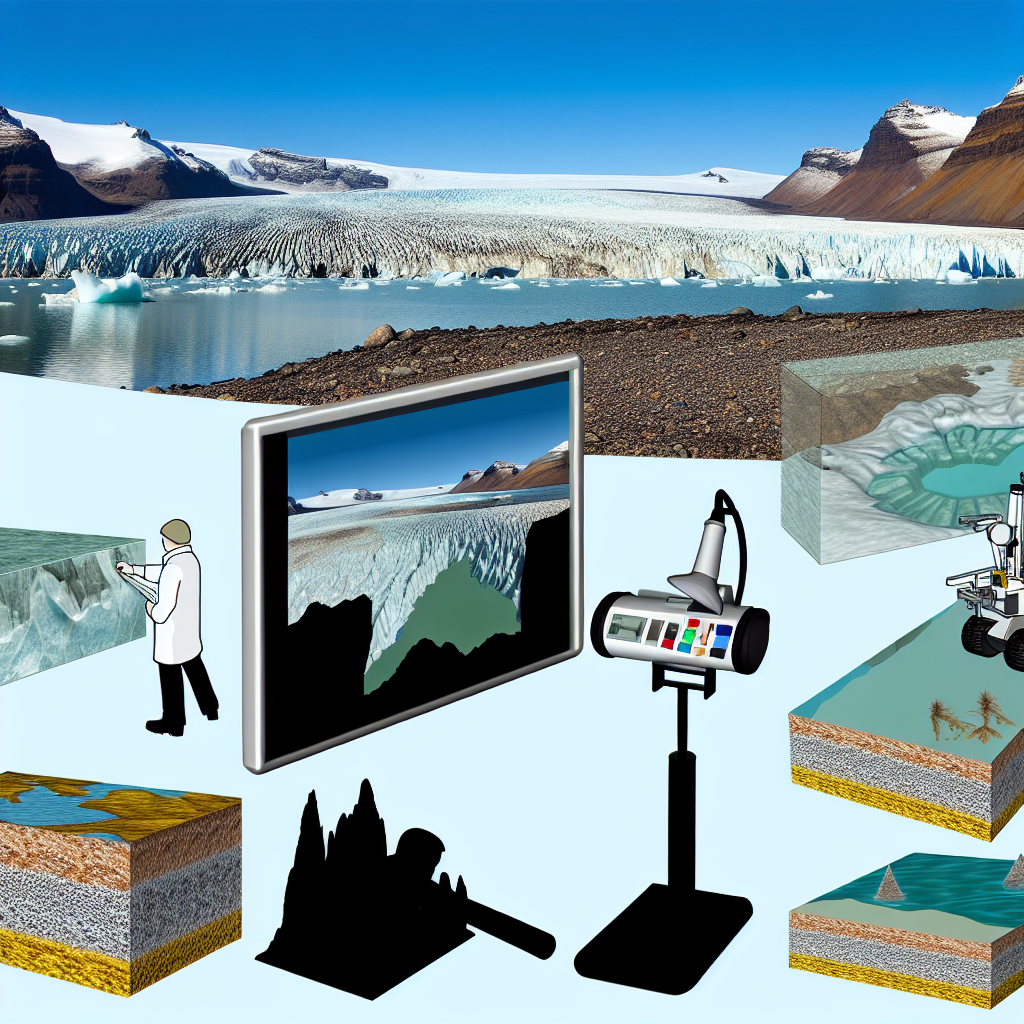
“What we’re going to do today is measure the glacial snout of the outlet glacier of Krossárjökull,” Jóhannes explains. Like the rest of the crew, he’s excited about today — despite being the park’s geoscientist, field trips like this one don’t happen often, as 75 percent of his work is spent in the office. “And then later on, we’re going to go down to Landeyjasandur, and measure one or two profiles of the coastline.”
In simple words, the data we collect during the expedition will help us monitor whether glaciers are receding or advancing, with most of them “sadly receding” as Jóhannes points out. When it comes to the coastline, we’ll monitor the changes in the width of the beach.
Being a citizen scientist means doing the exact same fieldwork real scientists are doing. Once the expedition is complete, you receive a Citizen Scientist Certificate from the Geopark, the results of your findings are sent to your email, your name is published in the Geopark’s report, and you get ongoing updates on the area of research. Not bad for a newbie scientist, right? Ann and Jóhannes assure me I don’t need a background in geology — I’ll learn everything on the job. And with that, off we go!
Photo by Art Bicnick
Hold on tight: river roads
As the super jeep turns into the highlands, the crisp September air reminds me that autumn is here: foliage on the trees is turning orange, puddles are frozen, and a flock of geese takes off, heading for warmer places. The ride starts to get bumpy, and as our driver Davíð lowers the tyre pressure, I know a few gnarly river crossings are ahead.
With a side-eye, I catch Art itching to be in the driver’s seat. A former rally racer, he hates being a passenger almost as much as he hates small talk. “Do you need help? I can do it,” he asks Davíð when the car submerges in the water for the first time.
Davíð shakes his head and focuses on the river. This one’s easy.
We continue through Þórsmörk for about an hour, crossing a few more rivers and manoeuvering around the bumps on the gravel road, until we approach the one we’ve been warned about. I’m watching the view out the window while doomscrolling a bit (in my defence, the gravel road makes it impossible to talk or focus on anything else), when I hear a loud noise. I look out and see that we’re in the middle of the river, stuck. Everyone goes silent and catches their breath. Davíð considers a few options and slowly backs up; the boulders in this section of the river are bigger than he thought. He steps out to check if the car is still in one piece, moves a few big rocks, then decides to drive a bit further and try a different spot. As all four wheels touch the ground, there’s encouraging applause from Ann.
Almost immediately, Davíð stops the car, saying this will be our parking spot — the terrain is too rugged for the car to continue. From here, we’ll hike for about 90 minutes to the glacier.
We start our hike with another river crossing almost immediately, this time on foot. This is the part I’ve been least looking forward to. My hiking boots are absolutely not waterproof — they once were, but now they have plenty of holes. So, following Ann’s recommendation, I packed an extra pair of sneakers. I change into them while the rest of the gang is already crossing the river. I see that for Jóhannes and Davíð the water reaches about knee-high, and my mind freezes. I really don’t want to do this.
But I also don’t want to be the person slowing down the group, so I grab the rope Davíð is holding on the other side and, gripping it, take my first step. I try to keep balance and make sure my foot is secure before taking another step. The river gets deeper, and, in the middle, it’s well past my knees. A few more steps, and I’m safe on the land. Jóhannes gives me a high five.
As I sit on a big rock, trying to warm my feet with my hat — the first thing I grab from my backpack — the shock of crossing a mountain river in September finally hits me. It feels like the glacier, with all its icy power, melted right onto my feet — colder than plunging into an ice hole in Finland or experiencing –36°C weather for the first time. The pain is excruciating, but the good news is it lasts only a minute.
The rest of the hike is along a flat valley, with views that take my breath away. Everything looks like it came straight out of a Jehovah’s Witness pamphlet — if you’ve never seen one, imagine the world dialled up a few shades. The moss is greener, the sky bluer, the cliffs more sculpted. Krossárjökull looms in the background.
Jóhannes is picking up rocks along the way, showing me his treasures. “This one is cool, it’s called ignimbrite,” he says, pointing to a patterned rock with visible fragments of other stones. Taking stones from nature in Iceland is highly illegal, but this is for research — and to display at the Geopark’s office.
In the scientist’s shoes
In about an hour, maybe an hour and a half, we reach the glacier. The landscape shifts slightly as we approach — the rock formations become otherworldly, crooked and curved, less mossy, and more deserted. The ground changes too: moss gives way to black quicksand. A few times, as I lift my leg to cross a stream, the ground collapses beneath my feet. One huge rock looks like a human-sized sculpture; another formation has a hole in the middle. I tease Art for a challenge: “Could you fly your drone through this hole and onto the glacier? Would make for an epic opening shot.” Art, who’s been carrying more equipment than all of us, gives a tired look and says, “I’m sure I’d just crash it.”
The crew splits ways for a bit — Davíð jumps across the river to see how we can access the ice cave. It’s the part of the expedition I’m most looking forward to. But very soon, Davíð reemerges to deliver the bad news — the ice cave is gone. Gone? What does he even mean?
In the year since Ann and Jóhannes visited the glacier the ice cave melted.
“Most of them [the glaciers] are retreating very fast,” says Jóhannes. He doesn’t seem surprised — I’m sure he’s seen this happen to other ice caves before.
As I’m trying to process the information, Jóhannes says encouragingly, “We are about to do some science.” Then adds, with a grin, “You are about to do some science.”
“Is this the very last chance I could see Krossárjökull?”
First, we need to take some drone shots of the area. He tells Art, Ann, and me to stand at specific distances from one another to form a rectangle. Jóhannes maps GPS coordinates at all four corners, the last one being his own, and then Ann proceeds to take drone photos of the designated area. She captures 90-degree-angle shots from 100, 200, and 300 metres high. “All of that is impactful information, and we’re able to kind of stitch things together and get a full profile and understanding of what’s happening across Krossárjökull today,” Ann explains.
Next, it’s my turn to do the actual mapping. Jóhannes hands me a Topcon GPS, which basically looks like a pole with a small computer attached. Using it is fairly simple, or at least it feels that even a five year old could handle the job. First, you place the pole in a stable position and make sure the bubble is inside the small circle for higher accuracy — then you just press the save button.
I repeat as Jóhannes instructed, walking along the edge of the glacier and saving the GPS mark every few metres. Jóhannes warns me to stop near the side that’s leaking. He points at dead ice, saying “it’s very rough and loose, so it’s difficult to traverse.”
I feel a sense of achievement thinking that this data could help real scientists monitor the speed of the glacier’s retreat, but I must admit that after doing this for a while I feel exhausted. The GPS is surprisingly heavy. As a writer, most of the time you can survive on coffee and a few nuts, but being a scientist requires a proper breakfast and some muscle — at least enough to carry the equipment with ease.
Just as I get into the groove, Jóhannes says we should wrap up and head back to the car — we have another location on our list today.
Off to the coast
As usual, the hike back to the car feels faster and easier. The river crossing, though, is still exhilarating — the cold bites through my soaked shoes, and my heart is racing.
When everyone makes it across the river, it’s time for a lunch break. We sit on the rocks under the chilly September sun and unpack our lunch bags, handed out to each of us by Ann in the morning. I’m a picky eater, so when I was told a packed lunch would be provided, my mind went blank: “I hope it’s not a Sómi sandwich. I hope it’s not a Sómi sandwich. I hope it’s not a Sómi sandwich.” To my surprise, Ann had actually prepared the lunch herself — everybody gets wraps, with a selection of snacks, fruit, and drinks. It satisfies the hunger of even the pickiest of us. Jóhannes finishes his wrap before Art warns him it’s actually a prop for his video idea.
On the way to the coast, the weight of the eventful day hangs in the air — everyone moves a little slower and mostly keeps silent. But once we arrive at Landeyjasandur, we get a burst of energy. It’s a glorious day to be at the beach.
My job as a citizen scientist here is similar — to map GPS points along the beach to see if the coastline is receding, which I know it is. Just a few weeks ago, it was reported that a seawall in Vík, just an hour and 20 minutes from where we are, had collapsed and a barn with sheep was washed into the sea.
I start near a wooden shipwreck — I’m told it’s a Danish supply vessel that stranded here about 100 years ago — and make a GPS mark every three steps or so. I continue this way until I come dangerously close to the waves. “I can do one more so you don’t get wet,” says Jóhannes, running into the water to take a final mark before the next wave hits the shore.
Photo by Art Bicnick
Photo by Art Bicnick
During the expedition, we talk a lot about the concept of last-chance tourism — a term I’ve never before associated with Iceland. Is this the very last chance I could see Krossárjökull?
“Maybe not last chance, but it will disappear very quickly,” says Jóhannes. “In the next few decades, for sure. Maybe in the next decade or two.”
He pauses and adds, “The good news is, the coastline will be there for quite a while. But the dynamic of the coastline is changing because of climate change, so we will be seeing bigger storms, with more extreme waves. It’s very important that we monitor our coastlines for the future, so we can see how the ocean level increase will affect the coastline here.”
Ann believes citizen scientists can play an important role in this process. “When we designed these expeditions, the idea was to make them impactful and to change the dynamic of how tourism is thought of — you know, [that] tourists just take from us, whereas this is an opportunity for tourists to actually give back, create this data that we need and that people in the offices in Reykjavik want and desire.”
Dear scientists, you’re welcome. Hope I didn’t mess up your data.
The trip was provided by Katla Geopark. Check out their science-driven expeditions and book yours at: katlageopark.com
Thanks for the wheels: graveltravel.is