

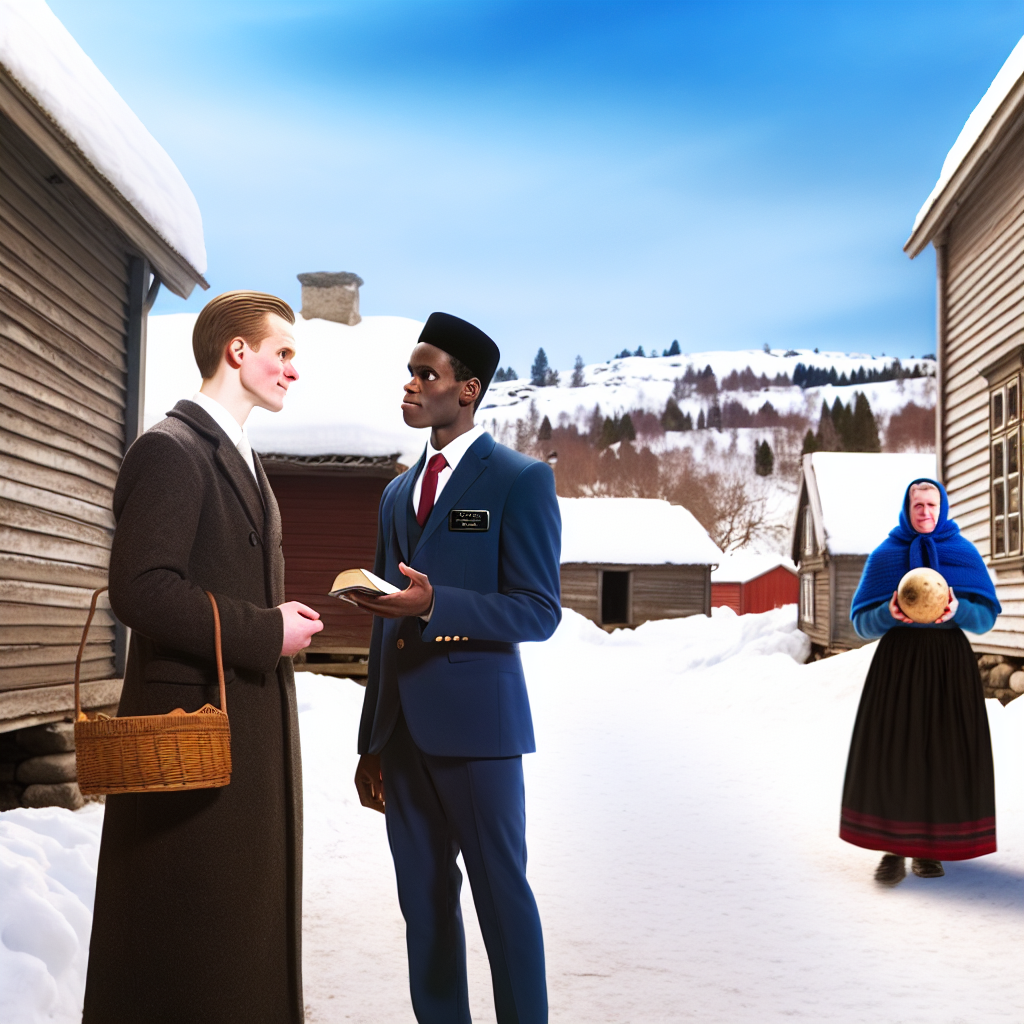
“In my opinion, we likely hold ourselves to a different standard here in Norway,” remarks Elder Larsen, a 19-year-old missionary. He stands alongside fellow missionary Elder Zurcher, 21, in the parking lot of their church. While the title “Elder” might suggest a seasoned figure, in the context of the Mormon church, it simply denotes their role as missionaries.
Arriving in a modest van, the young men are dressed in coordinated attire—beige chinos, wool jumpers, collared shirts, ties, and name tags—an outward sign of their commitment to their mission.
A Shared Journey of Faith
Despite their different backgrounds, there’s an uncanny parallel in the church affiliations of these missionaries. “I was born in Kristiansand,” Zurcher shares, reflecting on his upbringing in a deeply faith-driven family. “My family has been members for generations, yet it wasn’t until I relocated to the United States at 17 that I truly connected with the church.” His eyes light up as he explains how the more prominent faith culture helped him understand the value of belonging to a faith community.
Larsen, a native of Utah, echoes a similar sentiment. “Raised in a large family of believers, it was only after stepping away from home that I found my faith deepening,” he recounts. “Two years spent embracing a new culture, learning a new language, and sharing God’s message in Norway has undoubtedly strengthened my beliefs. It’s been a deeply personal journey.”
Faith, Doubt, and Discovery
Zurcher candidly admits, “I used to be someone who didn’t believe in much.” As our conversation shifts to the complexities of faith, he recounts his personal struggles and questions surrounding belief. Larsen quickly interjects, “The church does not advocate for blind faith. It’s about feeling something deep within.”
“For me,” Larsen continues, “it was during my exploration of the Book of Mormon. Engaging with the scriptures and praying to God cemented my faith.” He gestures toward a verse that emphasizes believing in things unseen, noting, “I know this is real—I’ve experienced it countless times, just like I know my phone will fall if I let go.”
However, Zurcher opens up about his earlier skepticism. “I actually thought a lot of it was completely wild and wrong,” he reflects. “Growing up surrounded by strong believers, I felt the need for my own experiences to truly embrace it. It was my bishop’s advice to delve into the scriptures that finally led me to my answers.”
When asked if they’ve encountered moments that validate their faith, they share a hint of uncertainty. Larsen explains, “It’s tough to articulate, because it’s the Holy Spirit that communicates with us.”
Cultural Misconceptions and Realities
The conversation then takes a lighthearted turn as they address common misconceptions about Mormonism, particularly curious practices like “soaking”—a pre-marital activity that has gained notoriety. “It has probably happened,” Larsen admits with a grin, “but most of these ideas stem from misunderstandings.”
They also weigh in on the popular reality show The Secret Lives of Mormon Wives, which provides a peek into the lives of Mormon women. “That doesn’t really align with our church’s values,” Zurcher argues. “While some featured might still identify with the church, it contradicts the very principles we stand for.”
As for polygamy, which many associate with early Mormon practices, Larsen clarifies, “That’s no longer allowed. There were times in history when it was practiced—Abraham, for instance, had multiple wives. But it’s not something we condone today.”
The prohibition against coffee consumption may seem puzzling to a coffee-loving Norwegian populace. With about 74 percent of adults enjoying their daily cup of joe, the missionaries explain their stance simply: “We abstain because we believe we are asked not to partake.”
Understanding Religious Texts
Larsen adds, “The Bible has undergone numerous translations, and much has been lost along the way.” He asserts the unique significance of the Book of Mormon, which they believe was translated directly by Prophet Joseph Smith in the early 19th century. “In that sense, it serves as a primary source,” he states.
Finally, Larsen emphasizes their belief in the restoration of Christ’s church on Earth, stating, “After the apostles’ era, we believe true teachings were lost, and it was Joseph Smith who was divinely appointed to restore them. This distinguishes us from other faiths.”
A Culture of Belief in Norway
Yet, do the missionaries sense a conflict between their faith and Norwegian societal values? “Not necessarily,” Larsen responds thoughtfully. While he does observe that the cultural norms regarding alcohol and pre-marital relationships differ greatly, he believes this is a trend seen widely in the U.S. as well. “Following Jesus often feels at odds with what’s popular,” he reflects.
The Future of Faith Among the Young
Both missionaries express optimism about the future of their faith, particularly among youth. “Globally, there’s a noticeable surge in religious sentiment among young people,” Zurcher points out. Recent statistics suggest a similar trend, with young Swedes identifying as believers rising from 20 to 34 percent over just four years.
“This reflects a broader quest for meaning and purpose,” Zurcher suggests, with many turning to faith for answers. “We believe the best answers lie here,” he adds with conviction.
Breaking Down Preconceptions
When asked what they hope people take away from their encounter, Larsen smiles. “The biggest misconception is that we’re not just ordinary people,” he asserts. “Our goal is to follow Jesus Christ and strive to embody his teachings—a journey towards self-improvement.”
Zurcher adds, “It’s a personal decision. We’re open to everyone, and we are, at our core, regular individuals trying our best.”