

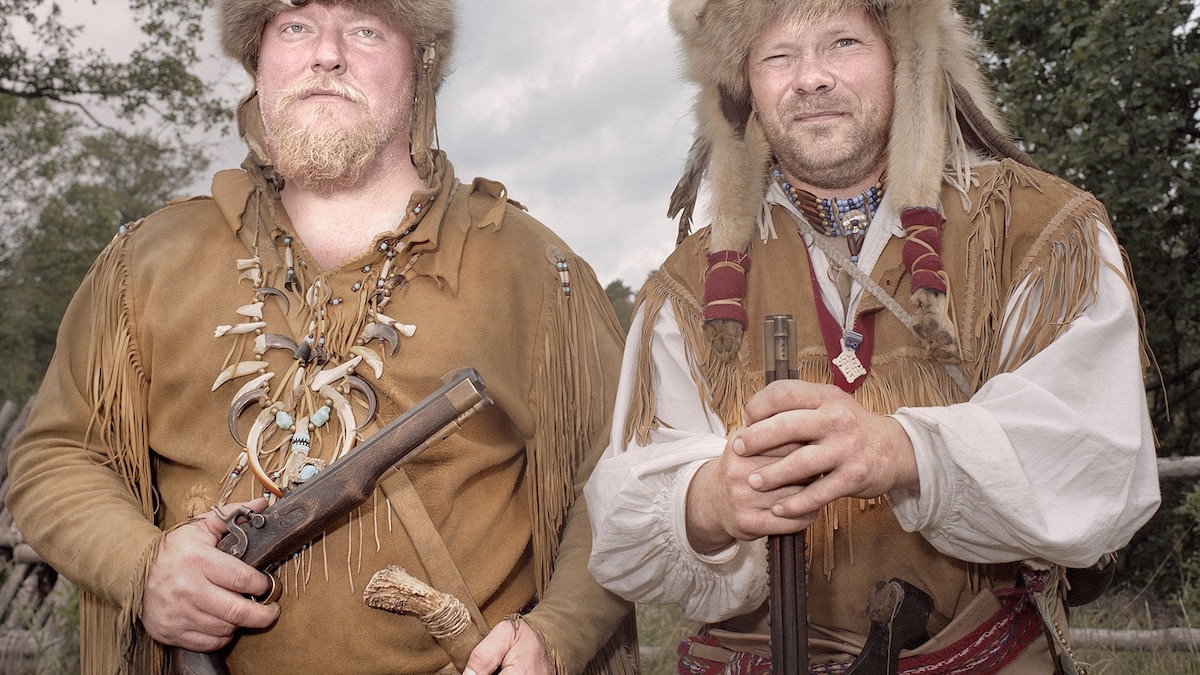
The same summer, she made her first trip across the pond to Sweden, where she photographed a Wild West theme park. “I discovered that Europeans were crazy about Native American culture as well as fur traders and the American Civil War. I never expected there to be such an interest in that period of American history.”
Since then, Harris has traveled everywhere from California to the Czech Republic, visiting these niche parks. Although the idea behind the parks in the US and Europe is the same—simulating the culture and history of a foreign country—the manifestations vary. “In America [the parks] tend to be in towns where people are descendants of immigrants from a particular area, like the Dutch who moved to Orange City, Iowa, or Holland, Michigan. They celebrate their heritage during events like Tulip Fest or Oktoberfest. In Europe, I find them to be more of a family holiday destination rather than being about cultural identity. There are entire amusement parks dedicated to the pioneering way of life, complete with Wild West shows and showdowns. There are also a few theme parks, like Sioux City, that were originally built as film sets during the ’60s and ’70s, when Spaghetti Westerns were popular.”
Many of the visitors haven’t actually traveled to the locations that the parks or towns are mimicking. “Often [it’s] zero to none. I was really amazed by how many people had never set foot in America, had no family there, and didn’t even speak the language yet knew everything about the Civil War, for example. The same is true for the Americans,” says Harris.
Some of the parks, she says, “have seen better days, with very archaic rides, and [they] are perhaps a little tame for today’s amusement park visitor. Others have [been] updated and modernized to continue to attract visitors.” She wonders if the parks will continue to hold the interest of generations to come, but she’s hopeful.
“In an era where our societies are becoming more homogenized due to the ease of travel and an abundance of access to information, I’m amazed that people are still interested in these bygone days. But maybe that’s the reason we are interested in the past and feel a need to preserve it. There’s a sense of fantasy to these places, a mythological atmosphere that isn’t always rooted in reality. That’s what I think is so special—that the depiction doesn’t have to be 100 percent accurate. Our curiosity in the other is why these places exist in the first place.”