

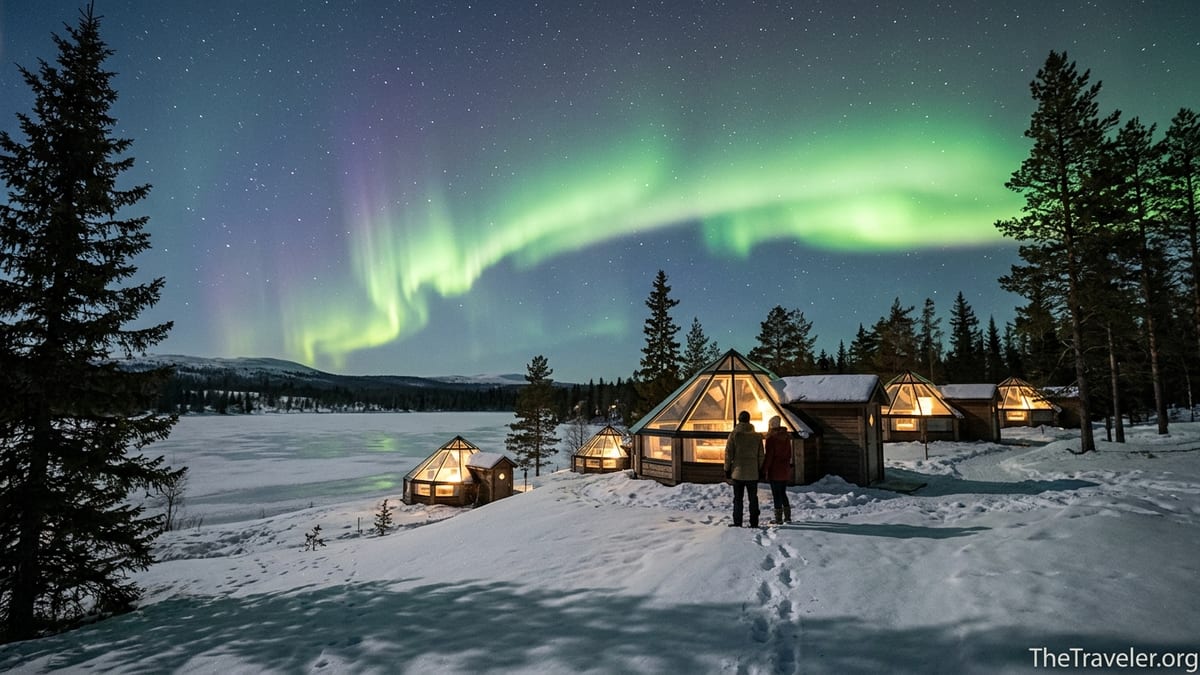
Across the Arctic, from coastal Norway to the forests of Finnish Lapland and the wide skies of northern Canada, the next two winters promise some of the strongest Northern Lights activity in more than a decade. With solar activity near its peak through early 2026, this is an exceptionally good moment to finally book that aurora trip you have been thinking about. The key is choosing tours, hotels and experiences that stack the odds in your favor while still feeling like a dream winter holiday rather than a scientific mission.
Get the latest updates straight to your inbox!
When and Where to Plan Your Northern Lights Trip This Season
Northern Lights are visible in a broad band across the high latitudes, from Alaska and northern Canada through Greenland, Iceland, and Scandinavia. In practice, most travelers focus on a handful of hubs with good flight connections, reliable tour infrastructure, and dark skies nearby. Tromso in northern Norway, Rovaniemi and Levi in Finnish Lapland, Reykjavik and Akureyri in Iceland, and Yellowknife and Whitehorse in Canada’s North all sit under or near the auroral oval, giving you a realistic chance of seeing the lights over a three to five night stay.
The best time to see the aurora is when nights are long and dark. In most Arctic destinations, that runs roughly from late August or early September through late March. Tour operators in northern Alaska, for example, publish dedicated “aurora season” schedules from about late August to mid or late April, while Finnish Lapland outfitters focus their Northern Lights programs between late August and mid-November for autumn, then again from December through March for deep winter. You do not need the dead of winter for strong displays, but you do need several hours of full darkness.
Right now, travelers also benefit from timing. We are in the peak years of Solar Cycle 25, with solar maximum falling roughly between late 2024 and early 2026. That means more frequent and more intense geomagnetic activity than during quieter years, which translates to a better chance of a bright show over the course of a short trip. You still cannot guarantee a sighting, but a long weekend in Tromso or a five-night stay in Yellowknife has better odds in the next couple of seasons than it did five years ago.
For most visitors from North America, the choice often comes down to convenience versus atmosphere. Iceland and Norway are easier to reach on overnight flights from the U.S. East Coast, with plenty of short three and four night packages including flights. Canadian destinations like Yellowknife, Whitehorse, and Churchill can be more logistically involved but may work out well if you are already combining the aurora with a broader Canada or Alaska itinerary.
Norway’s Tromso: Small-Group Chases, Fjords and Arctic Comfort
Tromso is one of the busiest Northern Lights hubs in the world, with a mature tour scene and many hotels that understand exactly what aurora travelers need. Through the main season from roughly October to March, dozens of companies run nightly aurora “chases,” heading out by minibus or mid-sized coach to wherever the sky looks clearest. Typical prices this season run around 1,100 to 1,800 Norwegian kroner per adult for a standard group chase lasting six to eight hours, which converts to roughly 100 to 170 U.S. dollars including transport, warm overalls, hot drinks, and help with photography.
Travelers who want more space and flexibility are increasingly choosing small-group tours. These often cap groups at eight to fifteen guests and cost in the region of 2,500 to 3,500 kroner, or about 215 to 300 euros, for a night out that can involve multiple stops, campfires, and detailed explanations of the forecast. Operators based in Tromso typically advertise that during peak months they can run at or near capacity, so booking at least a few weeks ahead for mid-January through early March is wise, especially if you are traveling over school holidays.
On the hotel front, Tromso has a cluster of comfortable mid-range properties right on the waterfront that work well as bases for tour-based trips. Prices fluctuate with demand, but for the 2025–2026 season a central four-star hotel room in February often starts in the vicinity of 200 to 300 U.S. dollars per night when booked in advance. Some travelers prefer to stay a little outside the city at small lodges or converted farm stays, trading easy restaurant access for darker skies and the possibility of seeing the aurora right from the property without joining a chase every night.
Beyond the lights themselves, Tromso also excels at Arctic add-ons. Dog-sledding half-day excursions usually cost around 1,800 to 2,500 kroner per person and include transfers, full winter clothing, and a hot meal. Snowmobile safaris in the Lyngen Alps or around Kvaloya sit in a similar price range. Many visitors structure their time so they book one or two high-energy daytime activities plus two or three dedicated aurora nights, leaving at least one evening free in case they need to move bookings to dodge bad weather.
Finland’s Glass Igloos: Sleep Under the Aurora in Lapland
If your idea of a perfect Northern Lights trip involves watching the sky dance above you while you stay warm in bed, Finnish Lapland is hard to beat. The region has become synonymous with “glass igloo” hotels and aurora cabins: compact wooden or log structures with heated glass roofs or panoramic windows angled toward the northern sky. Well-known examples include the igloos around Rovaniemi, the wilderness cabins near Inari Lake, and the clusters of glass-roofed domes outside Levi and Saariselka.
Rates for these properties vary widely by date and demand. Around peak winter weeks in late December and February, it is not unusual for a glass igloo for two with breakfast to price around 400 to 700 euros per night. At quieter times in early December or March, nightly rates may dip closer to the high 200s or low 300s, especially for stays of two or more nights. Many Lapland-focused tour operators now package these igloos into three to seven night itineraries that include airport transfers, half-board meals, a husky safari, reindeer visit, and at least one guided Northern Lights outing, with typical per-person prices for mid-range packages starting just under 1,000 U.S. dollars excluding international flights.
One important reality check: glass igloos are magical when the sky is clear and the aurora is active, but they are not a guarantee. Most Finnish Lapland experts advise pairing an igloo stay with at least one “mobile” aurora tour by minibus or snowmobile. In the Rovaniemi area, for instance, budget-friendly group aurora picnics start around 75 euros per person for about three hours, including a short drive away from town, grilled sausages over an open fire, and basic photography assistance. More intensive small-group hunts cost more but can travel farther to escape cloud cover.
Finnish Lapland also excels as a winter playground between aurora nights. Activity providers in Rovaniemi, Levi and similar hubs offer everything from snowshoe hikes through silent forests to overnight snowmobile expeditions, visits to ice restaurants, and, for families, Santa-themed experiences. Because many of these are weather dependent and can sell out during holiday weeks, it is worth pre-booking a core set of two or three activities and leaving a buffer day or two to swap things around if the aurora forecast suddenly looks exceptional.
Iceland and Multi-Day Aurora Circuits
Iceland has long been one of the easiest Aurora destinations for travelers from both North America and Europe, thanks to frequent flights into Reykjavik and a wide range of accommodation. Many visitors start with a simple one-evening Northern Lights bus or minibus outing from the capital. These large-bus tours can be good value, often pricing in the ballpark of 60 to 90 U.S. dollars per person for a three to four hour trip to darker locations outside the city when conditions look promising.
Over the past few seasons, however, multi-day aurora itineraries that combine classic Icelandic sights with Northern Lights hunting have become increasingly popular. A typical three-day small-group package might include the Golden Circle, South Coast waterfalls, an ice cave visit, and evening aurora searches, with rates from around 750 to 900 U.S. dollars per person in shoulder season. Longer seven or eight day circuits that loop around much of the country, such as escorted bus tours that operate in September and March, generally cost several thousand dollars per person including accommodation and breakfasts but offer multiple nights in quieter rural hotels where you can simply step outside if the forecast spikes.
Accommodation strategy in Iceland matters as much as tour choice. Staying in or just outside Reykjavik keeps logistics simple and gives you plenty of restaurant and cultural options but also means relying on vehicles to reach dark skies. Travelers who are comfortable with winter driving often split their time, spending a night or two in the capital then shifting to a countryside guesthouse on the Snaefellsnes Peninsula or near Vik, where the combination of minimal light pollution and ocean views can yield photogenic displays reflected on water or snow. Rental car and fuel costs add up, but for couples or families who want flexibility, the ability to check the forecast and move at will can be worth it.
For those cautious about weather disruptions, it is sensible to plan Iceland aurora trips in the shoulder months of late September, October, or March. These periods still offer long, dark nights but may bring slightly milder temperatures and less frequent storms than deep winter. Tour operators typically note that while December and January feel more quintessentially “Arctic,” shorter daylight hours can make the overall sightseeing program more compressed.
Canada and Alaska: Lodge-Based Aurora Viewing
On the North American side of the auroral oval, Canada’s Northwest Territories, Yukon, and northern Alberta, along with interior Alaska, offer exceptional Northern Lights viewing that often feels less crowded than European hotspots. Yellowknife and Whitehorse are especially well known for their high frequency of clear winter nights and purpose-built aurora viewing facilities, from heated teepees and domes to entire lodge complexes set away from city lights.
In Yellowknife, a classic arrangement involves staying in a modest downtown hotel or guesthouse and then heading out each night with a tour company that runs heated viewing cabins along nearby lakes. Three-night aurora packages that include accommodation, nightly transport to a viewing site, and sometimes daytime city tours commonly start around the low to mid 1,000 U.S. dollar range per person in recent seasons, with prices scaling up for private lodge stays and extra excursions like dog sledding or snowmobiling.
Alaska combines aurora viewing with distinctly local experiences. Around Fairbanks, for example, operators advertise “aurora season rates” for nightly excursions beginning in late August and running through mid-April, with peak frequency from about September through March. Visitors can base themselves in town or at remote lodges reachable by shuttle or small plane. In both Alaska and Canada, travelers who prefer a quieter, more nature-focused trip often choose a five to seven night stay at an all-inclusive wilderness lodge. These properties typically include full-board meals, guided excursions such as snowshoe walks or Indigenous cultural experiences, and nightly aurora watching from outdoor hot tubs or viewing decks.
Weather is a key consideration in these regions. While clear skies increase your chances of a sighting, midwinter temperatures in the Canadian North and Alaska can drop well below minus 20 degrees Celsius. Many tour operators provide insulated boots and parkas, but it is important to budget for high-quality base layers, headwear, and gloves if you do not already own them. Some lodges now offer rental clothing packages to make packing easier for visitors flying in from milder climates.
Aurora Cruises and Overland Expeditions
For travelers who prefer not to unpack every night, aurora-focused cruises and rail journeys offer a way to combine Northern Lights hunting with slow travel. Coastal voyages along Norway’s fjord-indented shoreline, for instance, run throughout the winter using expedition-style ships that spend a full week or more above the Arctic Circle. Several lines emphasize their “Northern Lights promise,” noting that if the aurora does not appear during the voyage, guests may receive a credit toward a future sailing. While conditions vary, the extended time at high latitude, away from city lights and with unobstructed horizons, can significantly improve your overall odds across the trip.
Cabin rates for winter coastal cruises in Norway vary by operator, length, and cabin category, but for the 2025–2026 season, entry-level interior cabins on off-peak departures can sometimes be found for just under 2,000 U.S. dollars per person for a week, with sea-view and balcony categories rising from there. Onboard, lectures by astronomers or experienced expedition guides help guests understand space weather, camera settings, and local folklore around the aurora, adding depth beyond the photo moment itself.
In Greenland and the Canadian Arctic, small-ship expeditions with a Northern Lights emphasis typically sail in early autumn, when seas are still navigable but nights are dark enough for sky-watching. These cruises are generally more expensive, often several thousand dollars per person even for shorter ten to twelve day itineraries, but they combine aurora opportunities with hikes among tundra landscapes, zodiac cruises along ice-filled fjords, and visits to remote communities.
On land, an alternative kind of “moving base” can be found in multi-country aurora coach tours. Some specialist operators run itineraries that start in northern Finland, cross into Sweden and Norway, and overnight in several small Arctic towns over a week. These trips usually bundle accommodation, most meals, and guided activities into a single price, making budgeting straightforward for travelers new to the region. Because much of the movement happens by day, you also gain a strong sense of the Arctic landscape instead of seeing only the sky above a single base town.
Budgeting, Booking Strategy and Avoiding Common Pitfalls
Before locking in specific dates and destinations, it is useful to sketch a realistic budget for an aurora trip, as costs can climb quickly. Recent price surveys across major Northern Lights hubs suggest that a three-night mid-range city-based trip in Tromso or Reykjavik, including one or two group aurora tours and a daytime excursion, often falls somewhere between 1,000 and 1,800 U.S. dollars per person excluding international flights. A five to seven night stay at a glass igloo resort in Lapland or an all-inclusive lodge in Canada’s North is more likely to sit in the 3,000 to 5,000 U.S. dollar range per person once meals, transfers, and multiple guided activities are included.
Booking strategy can meaningfully affect both your experience and your wallet. In Europe’s main aurora hubs, winter holiday periods from late December through early January and again around school winter breaks command higher hotel and tour prices and sell out earlier. If your dates are flexible, consider targeting early December, mid-January, or the first half of March, when you still have excellent aurora potential but may find better availability and slightly lower rates on everything from flights to igloo suites.
A common mistake is scheduling a single Northern Lights tour on the last night of your trip. Tour operators across the Arctic consistently advise spreading your aurora attempts across at least two or three separate nights, ideally early in your stay, so there is room to rebook if poor weather moves in. This does not necessarily mean buying three high-end small-group chases; many travelers mix one premium outing with one or two simpler trips or self-guided nights near their hotel if skies are clear.
Travel insurance with robust trip interruption coverage is also worth considering for aurora-focused travel, especially if you are connecting through airports prone to winter storms. While insurance will not refund you for cloudy nights, it can help if delays cause you to miss prepaid tours or non-refundable accommodation. When comparing policies, look closely at coverage for weather-related disruptions and missed connections rather than focusing solely on medical benefits.
The Takeaway
The coming aurora seasons, stretching through early 2026, are shaping up to be some of the most rewarding in years thanks to elevated solar activity. That creates a rare window when a thoughtfully planned three to five night trip has a stronger-than-usual chance of delivering the classic Northern Lights moment: curtains of green and violet light rippling silently overhead while snow crunches underfoot.
Ultimately, the best Northern Lights trip for you depends on how you like to travel. If you value lively towns and a big menu of tours, Tromso, Rovaniemi, and Reykjavik put you in the center of the action. If you prefer slow, contemplative nights under big skies, lodge-based stays in Canada, Alaska, or deep Finnish Lapland might suit you better. Whichever route you choose, focusing on multiple viewing nights, pairing stationary stays with at least one mobile chase, and booking key experiences early will go a long way toward tilting the odds in your favor.
No trip can guarantee the aurora, but with the right combination of location, timing, and flexibility, you can give yourself every reasonable chance. And even if the sky does not cooperate every night, the husky runs, snow-draped forests, Arctic harbors, and warm lodges of the far north offer enough magic in their own right to make the journey worthwhile.
FAQ
Q1. What is the best month this season to see the Northern Lights?
For most Arctic destinations, the prime window runs from roughly late September through late March. Within that, many local guides favor the periods from late September to early November and from mid-January to mid-March, when nights are long and tour operations are in full swing, though exact conditions vary year by year.
Q2. How many nights should I plan for a Northern Lights trip?
A stay of three to five nights in a good aurora destination gives most travelers a reasonable balance between cost and odds of success. With just one or two nights you rely heavily on luck, while a week or more markedly improves your chances but increases overall budget and time away.
Q3. Is it better to book a glass igloo or join nightly aurora tours?
The two experiences complement rather than replace each other. Glass igloos and aurora cabins are wonderful when the sky is clear above your accommodation, but a mobile tour by minibus, snowmobile, or boat can move to areas with better cloud conditions. Many travelers book one or two nights in a special-view room plus at least one guided chase.
Q4. How much should I budget for Northern Lights tours?
In current seasons, standard group aurora tours in popular hubs like Tromso, Rovaniemi, and Reykjavik typically cost the equivalent of about 80 to 170 U.S. dollars per person per night, depending on group size and inclusions. Premium small-group experiences, private guides, and overnight excursions can cost several hundred dollars per person.
Q5. Do I need professional camera gear to photograph the Northern Lights?
You can capture satisfying images with both modern smartphones and dedicated cameras. Many tours provide basic photography coaching and may share images with guests afterward. For the most control, a camera that allows manual settings, paired with a fast wide-angle lens and a small tripod, will yield the best results, but it is not strictly necessary for casual travelers.
Q6. How cold will it be on a Northern Lights tour?
Typical midwinter temperatures in aurora destinations range from just below freezing to below minus 20 degrees Celsius, depending on location and weather patterns. Coastal Norway and Iceland often feel milder but windier, while inland areas of Canada, Alaska, and Finnish Lapland can be significantly colder. Dressing in layers and using insulated boots, gloves, and headwear is essential.
Q7. Can I see the Northern Lights on a short city break?
Yes, if you choose a well-situated city with strong aurora infrastructure, such as Tromso, Reykjavik, or Rovaniemi, a three-night city break can include one or two evening tours into darker areas. Your chances are lower than on a week-long lodge stay, but many travelers do successfully see the lights on long weekends when conditions cooperate.
Q8. Are Northern Lights cruises worth considering?
Aurora-focused cruises along Norway’s coast and in parts of Greenland and the Canadian Arctic can be very effective for sky-watching because the ship spends many nights above the Arctic Circle away from urban light pollution. They also add value through onboard lectures and daytime shore excursions, though they tend to be more expensive than land-based trips.
Q9. How far in advance should I book for peak season?
For travel in late December, early January, or school holiday periods, it is prudent to book key elements like flights, special-view hotels, and small-group tours several months in advance. In Tromso and Lapland, for instance, popular tours can sell out weeks ahead during peak months, and signature glass igloos often fill first.
Q10. What if I do not see the Northern Lights during my trip?
Some tour companies and cruise lines offer limited “aurora guarantees,” such as a free rebooking or additional tour if conditions prevent sightings, but these policies vary. The most practical approach is to choose a destination with appealing daytime activities so that, even if the sky stays stubbornly cloudy, your trip still feels rich with Arctic experiences.